
I stumbled upon this unofficial website dedicated to him by a fan http://sheikhhamza.com and learned about his spiritual journey. In his early years as a muslim, he often had a dream about Murabbit Al-Hajj and he travelled the foreign land to seek him for guidance. He managed to find this blessed soul and this is the story of his encounter:
After two grueling days, we arrived in a beautiful town known as Geru, which at the time had no technology, and the buildings there were all a lovely adobe. Hundreds of students studied at seven madrassas, called mahdharain Geru. At night, with the exception of a few flashlights, candles, and kerosene lamps, all was dark so the Sahara night sky could be seen in all its stellar glory. The entire town was filled with the soothing sounds of the recitation of Qur’an and other texts.
We stayed with Shaykh Khatri, the brother of Murabit al-Hajj’s wife, Maryam, and a cousin of Murabit al-Hajj. While in Geru, I came to know a great saint and scholar, Sidi Minnu, who was already an old man at the time. He memorized all of the Hisn al-Hasin of Imam al-Jazari and recited it every day. His other time was spent in praying for the entire Ummah. Once, we were sitting on the sand and he picked some up with his hand and said to me, “Never be far away from the earth, for this is our mother.” He then said something that struck me to the core: “I have never regretted anything in my entire life, nor have I ever wished for anything that I did not or could not have, but right now I wish that I was a young man so that I could accompany you on this great journey of yours to seek knowledge for the sake of God.”
After a few days, we set out for Kamur, which we had passed on our way to Geru, and then took camels and set out for Murabit al-Hajj; by nightfall we arrived in Galaga, a valley with a large lake that rises and lowers with the rainfall and the seasons. After breakfast the next morning, we set out for the upper region some miles from where Murabit al-Hajj’s clan was encamped.
As we came into Tuwamirat, I was completely overwhelmed by its ethereal quality. It was the quintessential place that time forgot. The entire scene reminded me of something out of the Old Testament. Many of the people had never seen a white person before and the younger people had only heard about the French occupation, but never seen French people or other foreigners for that matter. I entered the tent of Murabit al-Hajj.
My eyes fell upon the most noble and majestic person I have ever seen in my life. He called me over, put his hand on my shoulder, welcomed me warmly, and then asked me, “Is it like the dream?” I burst into a flood of tears. I had indeed experienced a dream with him that was very similar to our actual meeting.[32]
Murabit al-Hajj
It was 1985, and the most life-changing part of Shaykh Hamza’s life would occur over the next 3 years. He sat at the school of Murabit al-Hajj and studied not only the sacred sciences, but also the traditional bedu way of life.
“Murabit al-Hajj’s birth name is Sidi Muhammad ould Fahfu al-Massumi, and he was nicknamed Hajj Umar by his mother after the great scholar and warrior, “Umar Tal of Senegal”.
During the blessed time that I was fortunate to have lived with him in his own tent, I observed his daily routine: He would usually awake at about 2:30 or 3:00 in the morning and begin the Tahajjud or night prayers. He would often recite for a few hours, and I heard him repeat verses over and over again and weep. Just before dawn, he would sit outside his tent and recite Qur’an, and then when the first light of dawn was discernible, he would walk to the open-air mosque and call the adhan. He would then pray his nafilah and wait for a short period and then call the iqamah. During that time, I never saw anyone else lead the prayer, and he would almost always recite from the last 60th of the Qur’an as is the Sunnah for a congressional Imam to do so according to Imam Malik.
After the sun rose and reached the level of a spear above the horizon, he would pray the sunrise rak’ahs and then return to his tent where he would have some milk brought fresh from a cow. He would then teach until about 11:00 in the morning and nap for a short while. After that, students would start coming again, and he would continue to teach until about 1:00pm at which time he would measure his shadow for the time of the midday prayer. He would then call the adhan at the time his shadow reached an arm’s length past the post meridian time as is the Maliki position on the midday prayer, if performed in congregation, to allow for others to come from their work after the heat dissipates. He would always pray four rakahs before and after the midday prayer and then return to his tent where he would teach until afternoon. He would usually have a small amount of rice and yogurt drink that is common in West Africa. Then, he would measure his shadow for the afternoon prayer, and when he ascertained its time, he would proceed to the mosque and call the adhan.
After Asr, Murabit al-Hajj would return to his tent and usually resume teaching and sometimes listen to students recite their Qur’an lessons from memory and he would correct their mistakes. During any lulls in his teaching, anyone in his presence could hear him say with almost every breath, “La ilaha illa Allah,” or he would recite Qur’an. At sunset, he would go and call the adhan, pray Maghrib, and then sit in the mihrab and recite his wird until the time of the night prayer. He would call the adhan, lead the pray and return to his tent. He would usually have some milk and a little couscous and then listen to students recite Qur’an or read Qur’an by himself. At around 9:00 pm he would admonish himself with lines of poetry from Imam Shafi’s Diwan and other well-known poets. He would often remember death with certain lines that he repeated over and over again, especially the following that I heard from him many times:
O my Lord, when that which there is repelling alights upon me,
And I find myself leaving this adobe
And become Your guest in a dark and lonely place,
Then make the host’s meal for his guest the removal of my wrongs.
A guest is always honored at the hands of a generous host,
And You are the Generous, the Creator, the Originiator.
Surely kings, as a way of displaying their magnanimity
Free their servants who have grown old in their service.
And I have grown old in Your service,
So free my soul from the Fire
He often repeats these lines for what seems like an eternity, his voice penetrating the hearts of all those within earshot. He once admonished me with lines of poetry, one after another, until I wanted the earth to swallow me. He said to me, “And what is man other than a comet that flashes brilliant light for a moment only to be reduced to ashes.”
He told me several times, “Hamza, this world is an ocean, and those who drown in it are untold numbers. Don’t drown.”
I have never seen anyone like him before him or after him, and I don’t think that I ever will. May Allah reward him for his service to this din and his love and concern for the Muslims. He was never known to speak ill of anyone. Once when a student was studying Khalil with him and asked what a certain word meant in the text, he explained to him that it was a slow and clumsy horse. The student then said, “like so-and-so’s horse?” At this Murabit al-Hajj suddenly became upset and said, “I don’t spend much time with people because they backbite, so if you want to study with me, you must never speak ill of anyone in my presence.” It is not well known by Muslims that to speak ill of someone’s animals falls under the ruling of backbiting.
Shaykh Murabit al-Hajj is a master of the sciences of Islam, but perhaps more wondrous than that, he has mastered his own soul. His discipline is almost angelic, and his presence is so majestic and ethereal that the one in it experiences a palpable stillness in the soul. As the Arabs says, “the one who hears is not as the one who has seen.” I was told by many people from his family that had I seen him in his youth, I would have been even more astonished at his devotional practices.
He is recognized in Mauritania as being one of the last great scholars, and his fatwa is highly respected among the people of West Africa who know of him, and they are many.”- For those critics of Syeikh Hamza, I guess we can only qualify to criticize him IF, and ONLY IF we have had similar courage to leave the comfort our our homes, loved ones and wordly possession to seek the real meaning of ISLAM in the name of Allah swt. If we haven't, then I think we should just shut-up and learn a thing or two about his experience.


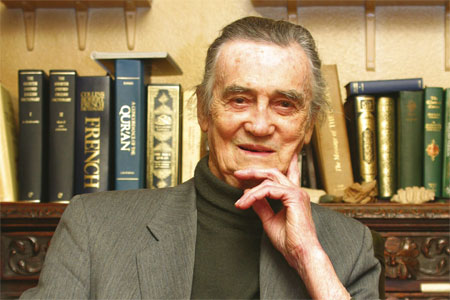 le bit peculiar to call his house after his passing. I was hoping to give my condolences to his family – instead, I got a chance to hear his voice one last time. On his answering machine, he still came through as the distinguished gentleman I had always known him to be. With the passing of Charles Le Gai Eaton, also known as Hassan Abdul-Hakeem, the last of a particular generation of remarkable western Muslims left this world – and certainly, he was one of the more influential of them, as attested by the numerous condolence messages from across the spectrum of British society and Anglophones everywhere.


